
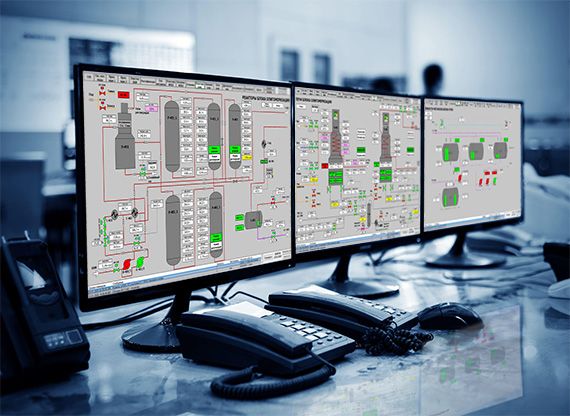
In industrial plants, SCADA (Supervisory Control and Data Acquisition) systems are among the most important automation components, enabling processes to be monitored, controlled and analyzed centrally. A well-designed SCADA system does more than display process data; by helping operators make fast and correct decisions, it directly affects production continuity, safety and efficiency.
SCADA screens that are not designed to standards, on the other hand, can lead to information overload, operator errors, difficulties in alarm management and longer maintenance work.
In the SANKOTEK Automation approach, SCADA systems are designed according to the principles of usability, consistency, readability and sustainability.
1. Screen Design Standards
SCADA screens are structured so that operators can reach the information they need quickly and easily.
To this end:
- Main process screens are designed to be simple and clear.
- Similar equipment is shown with the same appearance and symbols on all screens.
- Unnecessary graphics and animations are avoided.
- Critical process information is kept in the foreground.
Each screen is planned so that operators get the maximum information with the minimum number of actions.
2. Color Standards
In SCADA design, colors are used to convey information, not just for visual purposes.
Under our standards:
- Normal operating states are shown in neutral colors.
- Running equipment is shown in defined standard colors.
- Alarm and fault states are indicated with attention-grabbing colors.
- The same color standard is kept for all objects with the same meaning.
- Background colors are chosen to reduce eye strain during long periods of use.
Consistent use of color helps operators interpret the system faster.
3. Alarm Management
The alarm system is designed not only to show errors but to guide the operator to the right action.
In the SCADA alarm structure:
- Alarm priorities are classified.
- Alarm descriptions are written clearly.
- The time each alarm occurs is recorded.
- An alarm acknowledgement mechanism is used.
- Alarm history is stored in a reportable form.
- Filtering methods are applied to prevent nuisance alarms.
This approach reduces alarm floods and prevents critical events from being missed.
4. Trends and Data Monitoring
SCADA systems should support not only real-time monitoring but also the analysis of historical data.
Accordingly:
- Critical process variables are recorded as trends.
- Operators can review historical data over different time ranges.
- Alarm and process data can be analyzed together.
- A reportable data structure is created for performance evaluations.
Trend analysis contributes to early fault detection and process optimization.
5. User Authorization
Different user levels are defined in SCADA systems to prevent unauthorized interventions.
Standard user roles:
- Operator
- Maintenance staff
- Process engineer
- Administrator
Each user can only perform operations appropriate to their role.
6. Graphic Objects and Symbol Standards
All graphic objects used in SCADA projects are created according to defined standards.
- Equipment of the same type is shown with the same symbols.
- Valves, pumps, motors and sensors are represented with standard icons.
- Animations are used only where necessary.
- Naming standards are maintained for all objects.
This approach ensures visual consistency across screens in large projects.
7. Performance and System Optimization
SCADA applications aim for high performance and stable operation.
To this end:
- Unnecessary animations are avoided.
- Communication load is optimized.
- Data update rates are set according to process requirements.
Optimization improves the operator experience while using system resources efficiently.
8. Testing and Commissioning
Before commissioning, the SCADA system goes through comprehensive testing.
Tests carried out:
- Screen function tests
- Alarm tests
- Communication tests
- Trend verification tests
- Authorization checks
- PLC–SCADA data verification tests
All test results are recorded, making the commissioning process traceable.
Conclusion
SCADA design standards are a holistic engineering approach that aims not just at attractive screens but at improving operator safety, managing processes effectively and simplifying system maintenance.
With the SCADA design standards we apply at SANKOTEK Automation, we develop user-friendly, sustainable and high-performance automation solutions and make a reliable contribution to the digital transformation of industrial plants.